
2026 NSCR Norway-Sweden - 1
Bergen to Kristiansand


The North Sea cycle route, or the Eurovelo 12, is between 6.500 and 7.000 km long and seems to be the longest signposted cycle route in the world. The NSCR goes all around the North Sea via Belgium, the Netherlands, Germany, Denmark, Sweden, Norway, the United Kingdom and France.
We started this route in 2017 and randomly did several parts of it over the years (You can find all of them via the Trip Menu on this page under Related)
For this trip, we originally had the intention to take a train upto Hirtshals in Denmark and the ferry from Hirtshals to Bergen. Checking out schedules and prices, we finally settled for just taking the plane from Brussels to Bergen for a fraction of the price and time involved.
Sometime in February, our youngest daughter asked us to block a date in June for an event. Looking at the calendar, I (Dirk) suddenly got this uneasy feeling that our agenda was already filling up up to September without having reserved a few weeks for our next cycling vacation.
We immediately blocked the only free period of 5 consecutive weeks and decided within 2 days that this was the perfect timing to finalise our last part of the North Sea Cycle route in Norway and Sweden.
Weather statistics were showing May as the dryest month in this part of Norway with minimum average temperature of 7 degrees.

This is part 1 from Bergen to Kristiansand. If you want to go to part 2 from Kristiansand to Göteborg, push the Go To button at the end of this page or click here.
Video on DILISTUFF YouTube channel


The daily "Morning" shoot.
Every day, before we jump on the bike or go out for a walk, Linda takes a "Morning photo".
At the bottom of this page (menu item: Where, when and how), you'll find for each of these photo's where we stayed that night, where we cycled to, how much km's, in which location we had something to eat or snack and where we did our grocery shopping.

Bergen
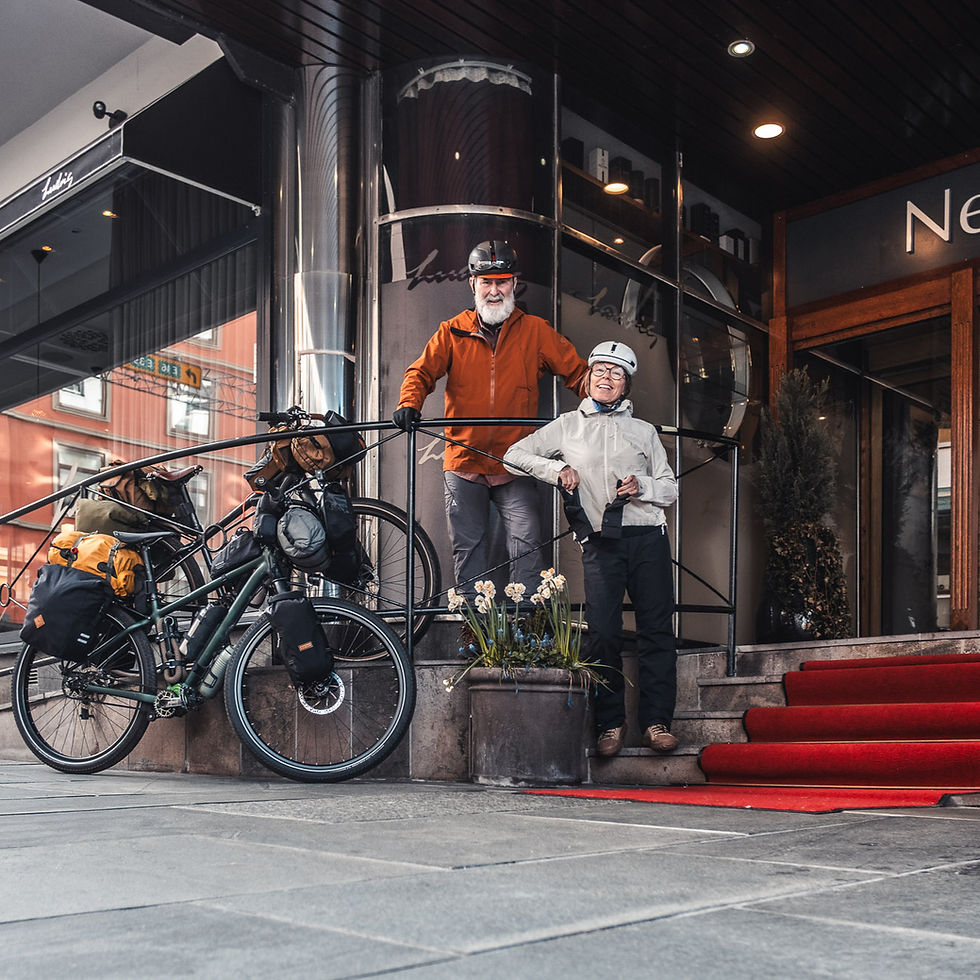
Bergen


Bergen
Day 1 & 2: Brussels to Bergen and visit Bergen

When we arrived in Bergen airport, only Linda's bike arrived on the luggage belt. Mine (Dirk) missed the transfer in Amsterdam and would be delivered to the hotel next day. Bad luck, not because 1 bike was missing but because both bikes were not missing. That would have made life so much easier.
Taking a taxi from Bergen airport to Bergen city is a challenge as you can only order taxis on a machine. No option for large luggage items.
Fortunately, there was a friendly bus driver who was prepared to accept our oversized bikebox and drop us at an imagined bus stop just 100 meters from our hotel.


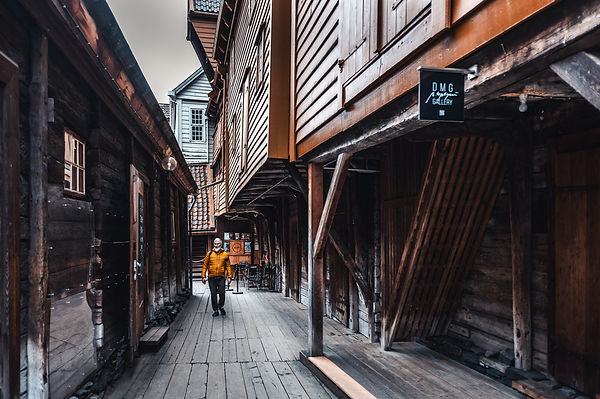
Bryggen (Norwegian for "the wharf") is the historic harbor district of Bergen.
At over 1.000 years old, it was originally founded as a trade center for stockfish.
A great fire in 1702 left the entire area in ashes and when the buildings were rebuild, their original architecture was carefully restored.


The 2nd bike arrived same day with the next flight and was immediately delivered to the hotel. Time to unpack and check if everything still works when the bikes are reassembled. While we always clearly mark the boxes with an UP sign, it's still possible that the boxes were upside down or on their side during transport. This can result in air bubbles trapped in the sealed fluid lines, causing malfunction of the braking system. (Not the case this time)
When this happens at home, no problem as bleeding or burping the brakes solves the problem. (I also always carry some brakefluid on our travels)
When on the road, try tying the brake lever to a closed (pulled) position overnight, allowing the bubbles to slowly move upwards and escape from the hydraulic lines.


Checking the weather forecast for the upcoming week, it will be OK tomorrow but the next 9 days are all showing rain and low temperatures between 0 and 5 degrees celcius. While we do not mind cycling in colder weather, the night temperatures for the upcoming week are also all below 0 degrees celcius.
Our sleeping bags are providing comfort temperature as from minimum +4 degrees. It means we will not be camping for the next 10 days. No problem as we also do not mind the luxury of a bed and ensuite bathroom.
And here is the next challenge, finding an affordable place to sleep. In booking.com, we really do not see a lot of options. When we visit the tourist office, they tell us that there is a countrywide hotel staff strike going on, resulting in to less availability and higher prices. Their advise: We better make reservations well in time. Whoops.


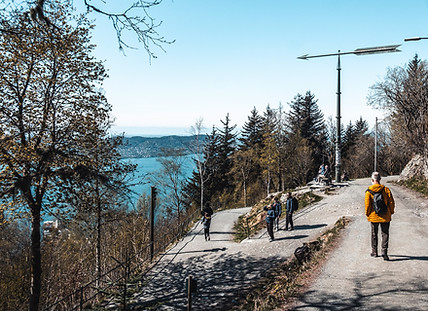
One of the "must do" things in Bergen is going up to Floyen for a fantastic view over Bergen.
The easy way is taking the Floibanen funicular up to the top and walk down to central Bergen.
The more sporty way is to also walk up which takes about 1 hour.
Somewhere in the middle, the path splits allowing you to walk up and down on a different path.


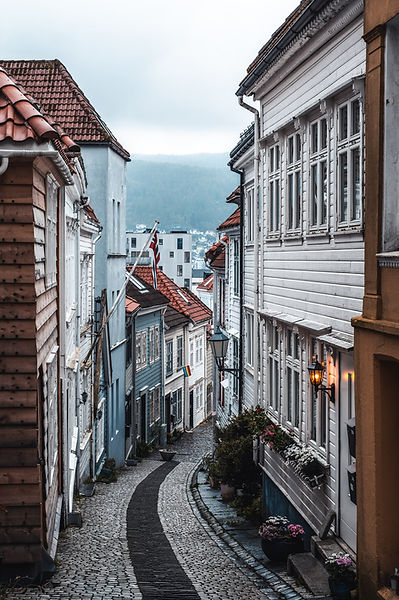
The Nordness peninsula is far less touristic and is an area with narrow alleys and beautiful old wooden houses, also characterized by great contrasts in architecture.
This is mainly due to the need for rebuilding after the many fires in the city over the years.

Bergen to Stavanger
Day 03: Bergen to Fitjar - 52km

Monday, May 4, 8am, 1st day on the bike and the weather forecast was wrong .... it's not raining ...... yet.
FIrst stop is after 14km at the outdoorshop "Naturkompaniet" in the Lagunen Storsenter. Yesterday, all shops in Bergen were closed and we still need to buy gas for our Trangia stove. We have booked a cabin at a campsite for this evening and we do not know if there are cooking facilities. When we called them to make the reservation, we were also told to bring groceries as there is no restaurant or shop in the neighbourhood.


Our first half day on the road in Norway already comes with 3 observations:
- It's certainly not a flat course. Is it really steeper than anywhere else or is it us getting older.
- Norwegians seem rather private and not very talkative.
- Outside the cities, buying healthy food is a challenge.
Around lunchtime, the first drops of rain fell out of the sky. Fortunately, we're just at a bus shelter, the ideal place for lunch.


After lunch, it just takes another 2 hours to reach Osøyro where there is a ferry crossing every 30 minutes to Sandvikvåg.
By the time we're on the ferry, we're really wet and we're shivering of the cold. Glad that we can drink a hot chocolate to warm up.


Another observation, the weather can change here in no time. Sunny, wind, rain and sunny again in 10 minutes.

We're the only guest at the campsite. Krako Gjestetun is at the borders of the Bjorna Fjord. The owner came to check us in after we called her. Season starts only as from mid june.
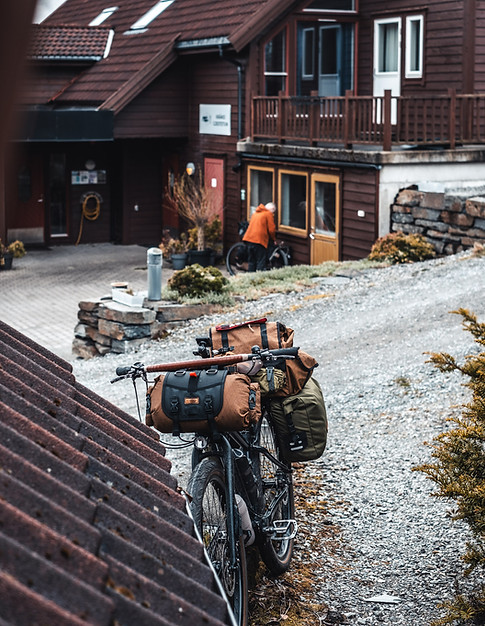


Day 4: Fitjar to Haugesund - 95 km

Last night, we looked at the next possibilities for lodging and it just seems that we will have to go as far as Haugesund for the first availabilities. There are still around 10 to 15 properties available. We will first make sure that we are able to catch the ferry to Buavåg and then make a reservation.


The views are amazing but there is also a doubtful feeling, we're most of the time on or next to larger roads. Not a lot of traffic, always very polite and careful drivers, but still, the road does not correspond with the nature views.


When we're on the ferry, we're checking booking.com again and there are only 2 out of the 15 options left for us in Haugesund. We're deciding on the cheapest one which is a small studio 4 km from the track. Still 160 euro's for the night.
The guy at the tourist office in Bergen was wright, we have to change our behaviour. We cannot do our usual thing - waiting till the very last minute.
We're having dinner at the Haugesund fishing port before we go to the studio. Tonight, we'll plan in detail for tomorrow - let's see if this works better.
Oh yes, weather forecast predicted a rainy day - We got a full day of sunshine.

Day 5: Haugesund to Skjoldastraumen - 30 km

Today and tomorrow will be very relaxed days. Not because we want to take it slow but because we have to change part of the route.
It's about 52 km's from Haugesund to Nedstrand, where we're supposed to take a ferry to Ombo, cycle 13 km and take another ferry to Hjelmeland.
Timingwise, there are no workable connections and no hotels allowing us to do it in multiple days.
If the night temperatures would not be below 0 degrees, we probably would have done it anyway and do some wildcamping.

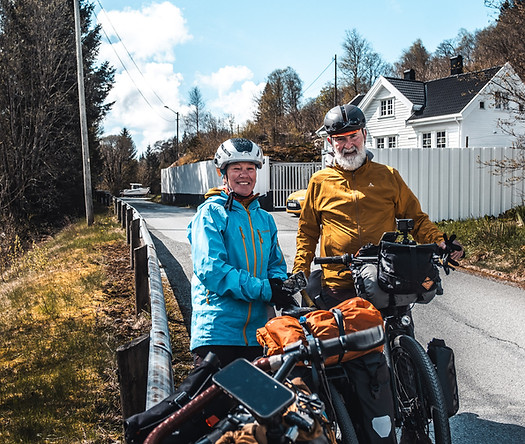
In the morning, we're meeting Suzy, the first cyclist on our route.
She's cycling to the Lofoten, maybe even the Nordcape and managed to get all the right ferries. Coming from the other direction, it was a better match and she was wildcamping with gear suitable for the freezing temperatures. Respect.
Our revised plan is to take the fast ferry from Nedstrand to Stavanger which leaves every day in the early morning and in the afternoon.
With no hotel in Nedstrand and after yesterday's 95 km with elevation gain of more than 1500 meters, we decide that we do not want to rush today and also do not want to miss the last ferry.
The last place to sleep before Nedstrand is halfway, in Skjoldastraumen. Only one place available so no hesitation this time.

We're also getting used to the reservedness of our hosts.
Yesterday, we stayed in a studio next to the apartment of the owners. We got a code for the keybox and they obviously saw us arriving by bike. As they were concerned that we thought that the bikes had to stay outside in the rain, they logged in to booking.com to send us a friendly email that we could take the bikes inside.
Also tonight, the owners were home but no personal contact at all.


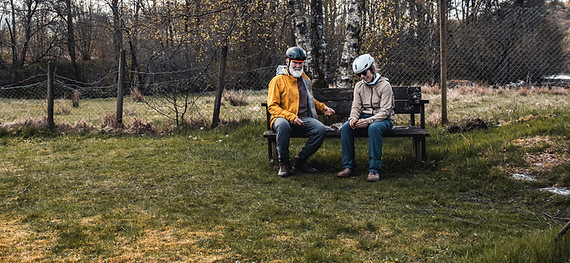

Day 6: Skjoldastraumen to Nedstrand - 27 km
Fast ferry to Stavanger

Another relaxing day. The route between Haugesund and Nedstrand was described as challenging but this was obviously only related to the first part which we did yesterday. Today, it seems all downhill. If we would have known this before, we could have done it in 1 go to be in time for the afternoon ferry.
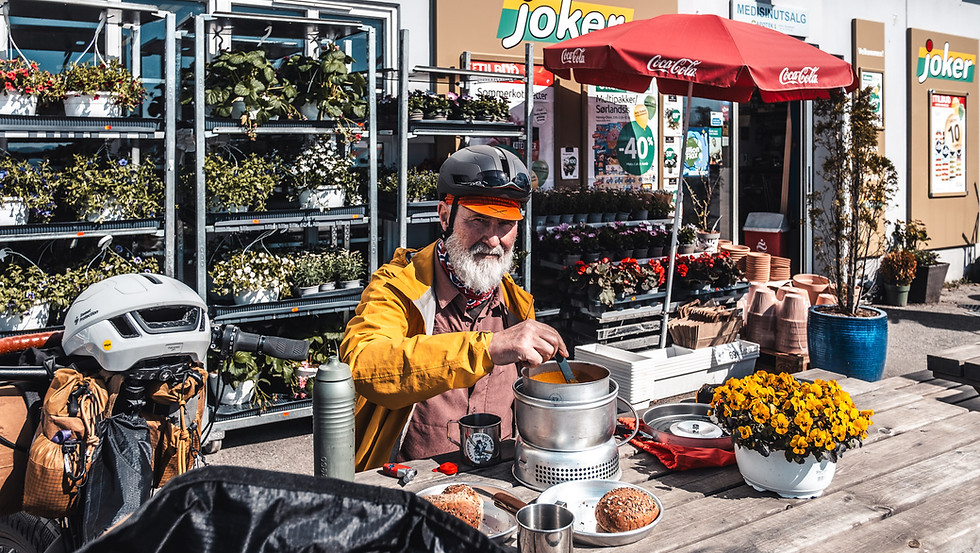
We arrived at the pier around lunch time and were happy that there was a Joker supermarket with picnic tables.
Good time to take out our Trangia stove.
On the menu: Soup with bread rolls, an icecream stick and hot chocolate.


And yes, after 6 days in Norway, our first spontaneous contact with a local.

Public transport in Rogaland is done by Kolumbus and they operate both the buses and ferries.
The ferry stops at the pier like a bus on a bus stop, the gangway is already going down when the ferry approaches the quay, you get on immediately and the ferry leaves immediately when your last foot is on the boat.
The ferry from Nedstrand to Stavanger is a fully electric high speed ferry cruising at 23 knots (45 km/hour) and takes 1hour and 30 minutes to reach Stavanger.
You can buy tickets via the app or website and bicycles go for free on the ferries.


Stavanger
Day 7: day of rest - 0 km

Stavanger became the center of Norway's offshore oil industry after oil was discovered in the late 1960's.
It's also one of the oldest settlements in Norway and it's old town boasts 173 restored wooden buildings.
From a culinary point of view, local specialities include fresh shrimp, crab, atlantic salmon and cod, all for sale directly from the fishermen at the harbour.



Øvre Holmegate or "Fargegaten", is known as the colourfull street.
The wooden houses in this area are painted in eye-popping greens, oranges and pinks. It's home to trendy bars, cafes and boutiques.


Stavanger is certainly a gateway to many of Norwegians highlights, such as the Pulpit Rock hike (Preikestolen), the Kjerag hike, or a cruise on the Lysefjord. Being just at the beginning of our trip and with a not so glorious weather forecast for next week, we decided to do all this another time. Let's first finish this part.

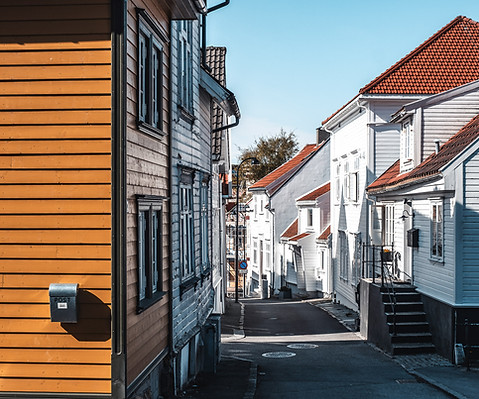


Old Stavanger, also known as Gamle Stavanger is a popular living area with many galleries, restaurants and handicraft boutiques.
In the old days, it was quite common to bring your house if you moved from one place to another.
The houses were logged in timberr, making it fairly easy to dismantle and bring along when moving.
Tip for dinner: Restaurant Bravo at Pedersgata 71. Looking for a nice restaurant, we found out that most restaurants were already fully booked. It was of course a friday evening, the sun was shining and everyone was out. When we checked with this one, they just had 1 table left outside on the terras at 5.30pm. What a surprise, we took a standard shared menu with 5 dishes, all amazing.


Stavanger to Kristiansand
Day 08: Stavanger to Egersund - 106 km



After a couple of relaxing days, we're again ready for the big work. It's still freezing during the night so we're bound to find a place inside to sleep.
Between Stavanger and Egersund, there is nothing. This means we'll have to do a little more than 100 km today but there are 2 comforting elements:
- our host tells us he has been doing this with his racebike several times and it's mostly downhill (?). Max 200 meters climbing during the last 15 km between Ogna and Egersund.
- there are train stations along the way so we can abort the ride and jump on a train along the way.
Let's go
We're on the road just after eight and it really goes fine. When we start seeing the road going up and down, we just check Linda's Strava which shows that we have done about 20 km's and we already have an elevation gain of 265 meters. Oops.
Obviously, our host has been riding on a different road to Egersund and did not follow the North Sea cycle route or the Nordsjø route number 1.


It's the first day that the route also resembles the Nord Sea route we know from Belgium and the Netherlands.
Long stretches of beach and sand dunes.
We're not complaining as by lunchtime, we're halfway. While the weather forecast predicted rain, we have not seen a drop falling out of the sky.
We're again lucky.
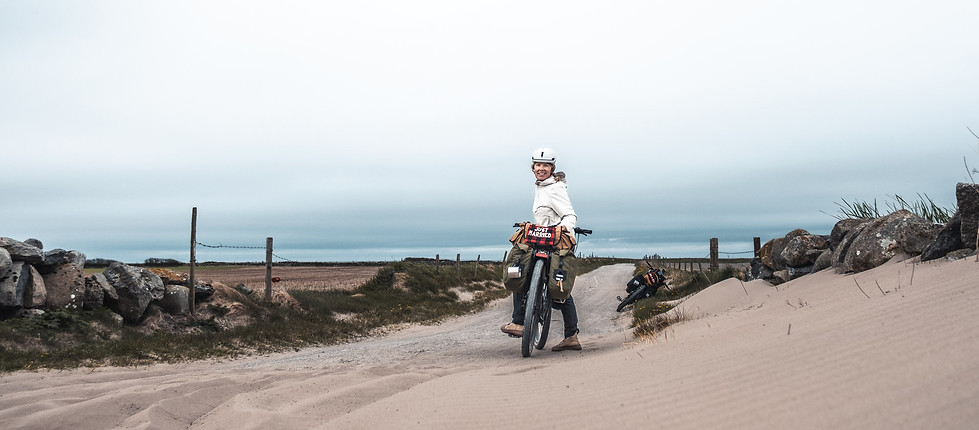
Also very happy that we're away from the bigger and paved roads whenever possible. It seems that this part of the NSCR is made by a different person.
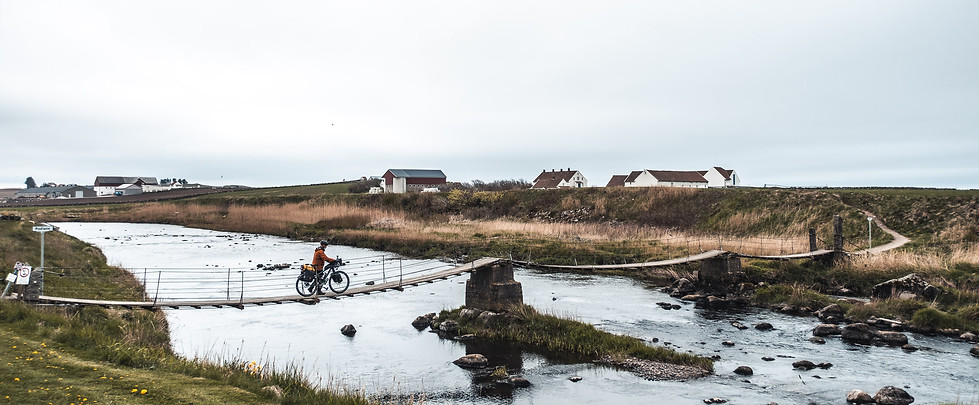


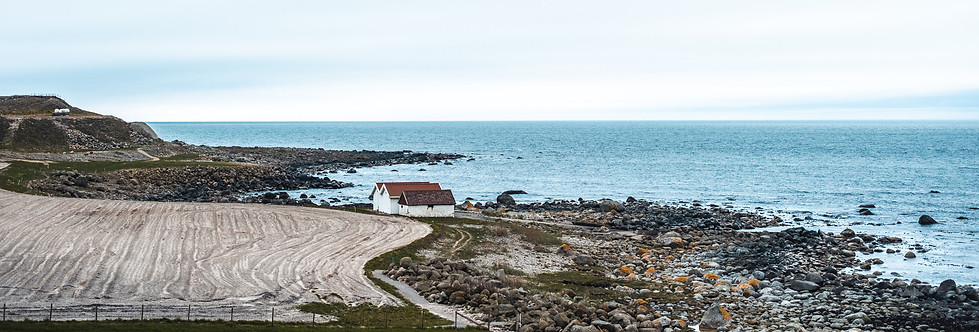
While it all went fast this morning, we are now slowing down tremendously as there seems to be the perfect spot for a photo or video around every corner. On top of it, we're all alone here. It's all peace and quiet. Just the sound of rolling waves and a single bird flying over.


Arriving in Ogna around 4 PM, this is the last opportunity to get on the train to Egersund. The next 20 km will be the most challenging but we're op for it.
We're also passing the campsite which we called yesterday evening to check if they have a cabin available.
Season starts here on june 20 only and they only accept campervans who are fully independant.
Camp kitchen and toilet facilities are all still closed.


This really goes up.
The "Old main road of West Norway" is a historic 19th century trunk road.
Originally build as a riding path in 1810 over the Hegrestadfjellet mountains, it was widened for horse and carriage by 1820.
Today it serves as a stunning rugged hiking and biking trail through the Magma Geopark.

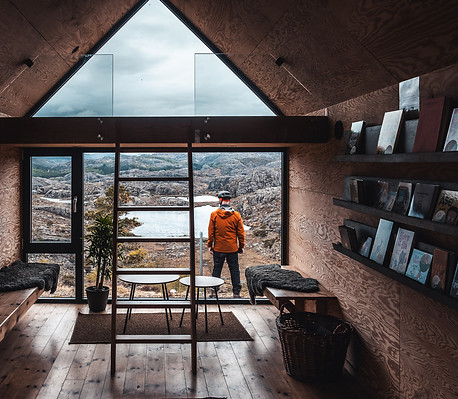
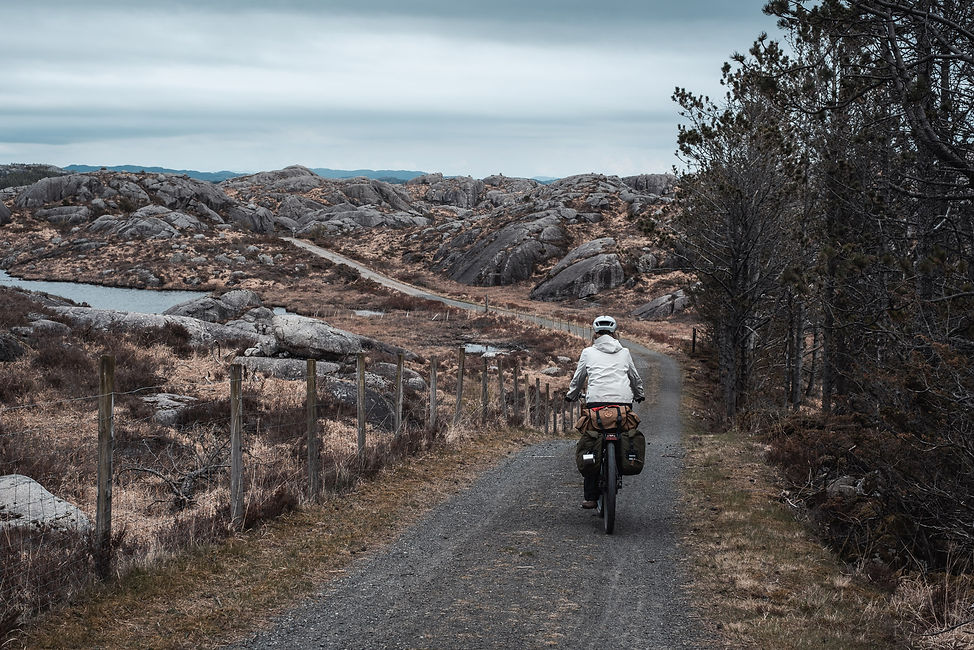
By 7 pm, we're finally in Egersund, it was a very good day.
... and we had 1380 meters elevation gain, just a little more than the 200 we were expecting.
No pain, no gain.


Day 09: Egersund to Flekkefjord - 73 km

Since yesterday. there is an oversupply of picture perfect landscapes.
Our plan is to stop for lunch in Sogndals-strand. One of Linda's followers on Instagram mentioned that this was one of the cutest villages of Norway.
After 20 km's , we're meeting a German couple who started their cycle trip in Malaga and are on the way to the Nordcape. They tell us that it really gets tough going up to Flekkefjord. They only managed to do 25 km's in 3 hours and stopped for the day after 55 km's.
Oops, our plan today was 75 km and they're even not half our age.
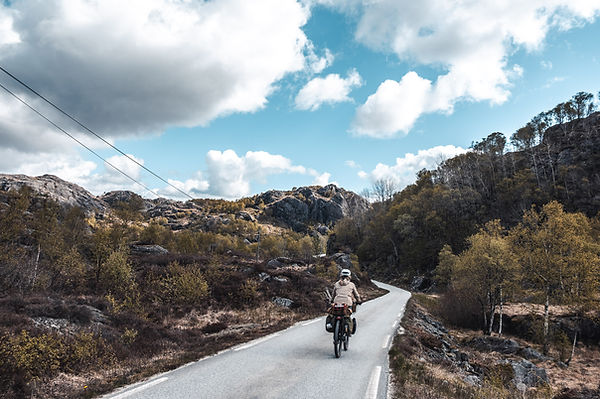


Sogndalsstranda is indeed worth visiting. It has pedestrian streets, small shops and galleries and a salmon river is floating though the village.
But ..... it's Sunday and everything is closed.
The only hotel in the village is closed for a private event and we can only get a cup of coffee. Fortunately, we came prepared and have some breadrolls and cheese in our panniers.


Leaving Sogndal, we're on the part of the Nordsjøvegen ( North Sea road) which is also dubbed "the wildest road in the country".
Keeping in mind the story of the German cyclists, we have not booked lodging in Flekkefjord yet. When we reach Ana-Sira, we will decide if we're still ok to continue up to Flekkefjord or stay in Ana-Sira where 1 appartement is available for tonight.
It seems, there's also a supermarket which is open 7/7 and 24/24. Let's find out what this is.


While cars now pass through a modern tunnel, pedestrians and cyclists still use the 1920's Old Road Tunnel. Blasted straight through the rock, it feautures viewing holes allowing you to look directly down in to the fjord.


Located at the bottom of the fjord, 2 ancient unpainted wooden houses (the Helleren settlement) have been built directly under a massive overhanging cliff that provides natural protection


It's 4 pm when we arrive in Ana-Sira. No restaurants here so we decide to continue another 20 km to Flekkefjord.
The Joker supermarket which is open 7 on 7 and 24 hours a day is an unmanned supermarket.
You get in by swiping your creditcard for an amount of 1 NOK. All you want to buy is self scan. Door opens again when you have paid your goods.
Of course, you're on camera during your entire visit.
Super efficient.


Day 10: Flekkefjord to Farsund - 63 km

We're leaving Flekkefjord in a light drizzle, strange as the forecast only mentions rain in the afternoon.
The plan is to go as far as Vestbygd where we still have a few availabilities for apartments. If we're still in the mood, it will be just another 16 km to Farsund for what seems to be a nice hotel.
There, we will probably book for 2 nights as the last couple of days have been rather tough and our muscles feel like they would appreciate a day of rest

It does not take long before we are going offroad, very nice. Whenever we are again on a main road, it's clearly just a small intermezzo before we are again alone on deserted roads. Perfect


As usual, we're planning in the morning where we will stop to buy lunch. Today, it's in Feda, some 15 km's down the road.

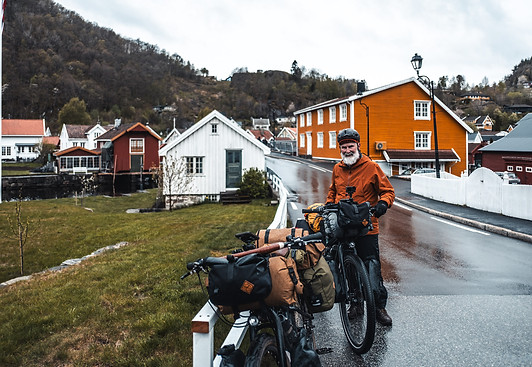
While Linda is buying food, I (Dirk) am having a conversation (finally) with a local who asks us if we take the long "steep" road over the mountain or we take the easy road next to the Fedafjorden. He explains that the road next to the fjord is only taken by locals and although there is 1 tunnel, it's very safe as you can push a button before entering the tunnel which warns all cars that there are cyclists in the tunnel.
When Linda comes back, I convince her to take the quicker and easier road as we still have a long way to go today.

Looking back, it was probably not the best decision.
While it was certainly the easiest and fastest way to cycle around the Fedafjorden, it also made Linda rather nervous.
The majority of local traffic were heavy trucks, we were all the time cycling on a bigger road and the tunnel was a bit too long to be comfy.
Lesson learned again.


Suddenly, totally out of the blue, wind starts blowing very hard and it rains cats and dogs. Linda's shoes are filling up with water. When we see a signpost direction Farsund making our route 30 km's shorter, we have a management meeting in a bus shelter and both cometo the conclusion that taking a shortcut again is certainly the best option.


It's now just 20 km to Farsund and we straight away make the hotel booking for 2 nights.
When I ask the route app (Pocket Earth) to plot the route to the hotel, it's 4 km longer then distance on the signpost.
Most probably, the shorter distance was partly on a road not allowed for cyclists.
Anyhow, the views are certainly worth the detour and it also stopped raining.
By the time we're arriving at the hotel, we're already parcially dried up, except for Linda's shoes.


2 Nights at the same place always means time for doing our handwash laundry. The bicycles are on our terras and the perfect rack for hanging our clothes to dry.
Day 11: Farsund - 0 km

Day of rest. It seems we're more in need of rest days than usual. Last year in Scotland, there would always be at least 5 to 7 days between rest days but here, we're kind of more in need for a break. This is our 2nd restday after 8 days of cycling. Of course, the weather is more challenging and the elevation gain is also a lot more than anything we had on previous trips.


Always mixed feelings with a rest day. You know that your muscles need it but if the sun is shining and there's not a lot to do, it just feels like a waste of time.


Day 12: Farsund to Lindesnes - 40 km

The perfect plan for today. It's about 40 km to Lindesnes where we have booked a room in the Havhotell. When we arrive there in the early afternoon, we first unload our bikes and continue with our naked bikes to the Lindesnes lighthouse. That's a to and fro of 24 km's in total.


The sky is cloudy, the track is perfect.
Just before noon, the weather suddenly changes and it starts raining again. It rains, it rains, it keeps on raining.
We're arriving at 1.30 pm at the hotel and are soaked. Change of plan.
The round trip to the Lindesness lighthouse will be for tomorrow morning.
Although it was only 40 km today, it was certainly enough. We started and ended at sea level. Our gps gives elevation gain of more than 900 meters which means that the average inclination level was close to 5%. We're getting better at it.


Later in the afternoon, it again all clears up and as we use it as an opportunity to explore the area and do our shopping. Tomorrow is Ascension day and all shops will be closed. We better make sure we have all we need for lunch and dinner already.


When we're stepping outside of the hotel, we can see a little further, at the other side of the bay, a strange building which just seems to be gliding in to the water.
Approaching the building, we do not see any signboards giving us a hint what this building is all about. Walking up the walkway (and ignoring the sign "reservations only") someone comes out and asks if we have a reservation. oops.
Explaining that we have no idea what we're supposed to have a reservation for, the nicely dressed lady explain us that "Under" is a Michelin star restaurant. The dining room with panoramic windows is 5 meters under the sea.
Set 12 course dinner at 250 Euro per person, an extra 200 euro's for wine pairing. Well, we already had dinner at the hotel and "Under" was already fully booked for the next few months anyhow.


Day 13: Lindesnes to Høllen - 96 km


Starting with the round trip to the lighthouse, there's a lot of wind but without our luggage, it feels like we are flying.
As expected, everything is closed today.


There's a little bit of bad news and a lot of good news.
Today will be mainly overcast with some rain towards the evening.
The next 2 days will be 100 % rain. And here it comes :
ALL the days after - sunshine - no rain during the day and temperatures slowly climbing.
What this means, today we will cycle till it really starts raining, leaving the shortest possible part to Kristiansand for tomorrow.
We'll book 2 nights in Kristiansand to bridge the raindays.


Before we leave, fully packed again, Linda cannot resist another photoshoot at the boathouses next top the hotel.

We also have to rethink our opinion about Norwegians. It just seems that Norway is not different from most of the other countries we've visited by bicycle.
The further south you go in a country, the more talkative and approachable people are.
This is exactly the same in Belgium where people in the south will always greet you, and those from the north will not.
Same for The Netherlands, France, Spain, etc...
The strange thing is that the south of these countries always borders the north of the other country.


When we stop for lunch, a resident walks over to us and tells us that we can use the picnic table in his garden, just across the road at the Sniksfjorden.

Our initial doubts if it was a good idea to do this part in Norway are slowly fading away. Surely it has something to do with the weather, the traffic, the people. It all starts to go in the right direction.


We're passing a couple of places where there is available lodging but we decide every time to continue till it really starts raining.

Around 5 pm, the first rain hits our face and we are lucky that there is a campsite nearby where we can have a cabin.
The convenience shop at the campsite is not open yet but we came prepared. We bought food for dinner yesterday. Tomorrow morning, we'll have breakfast on the road.


Day 13: Høllen to Kristiansand - 20 km
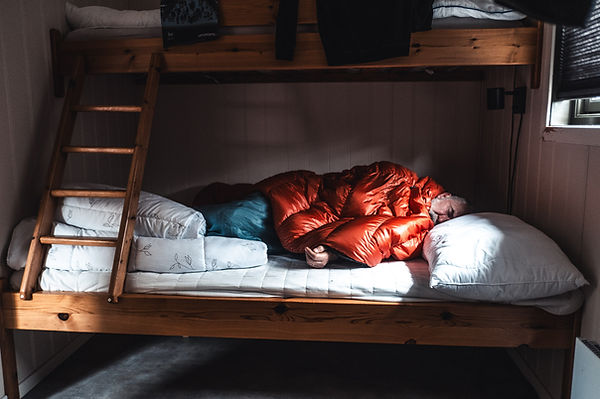

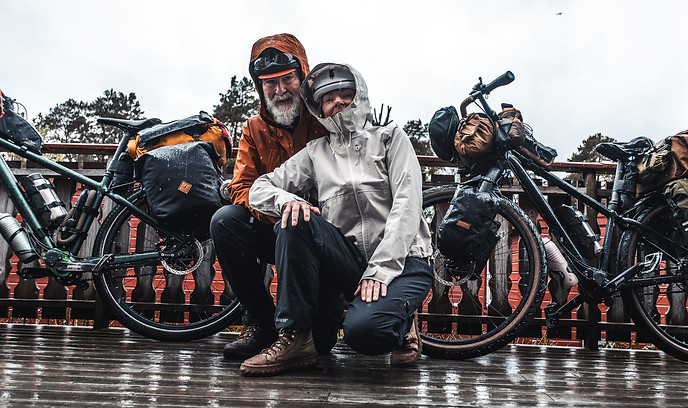
Waking up in the morning, we could already hear the rain gusting down.
No problem, we only have to do 20 km's to Kristiansand where we will stay for 2 nights. Time enough to dry everything what's wet.
It's maybe 500 meters from the cabin to the reception where we have to deposit the key.
Yes, 500 meters is enough to be entirely wet.
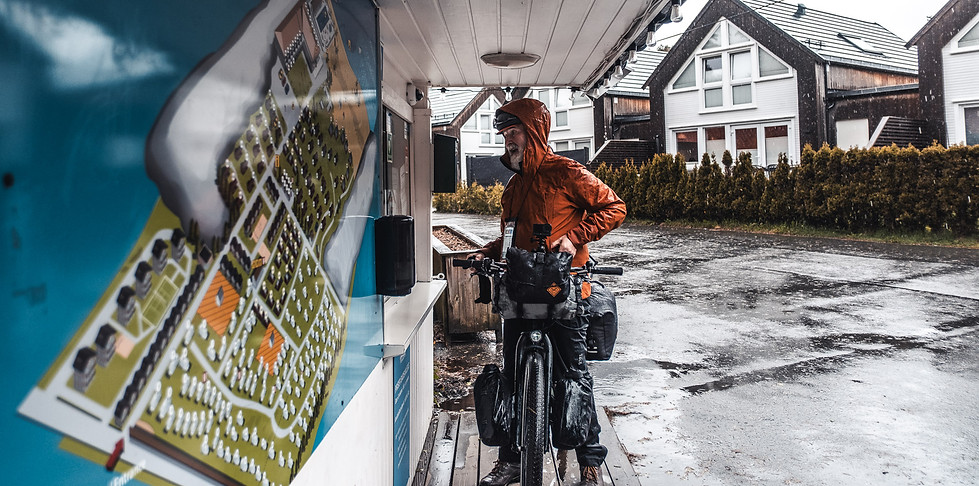

It's a good test of our new Restrap panniers which replace our older Ortlieb ones.
I (Dirk) have been using a Restrap roll top handlebar bag for about 6 years and we also started using the Restrap bikepacking gear for our gravel bikes since last year.
We've now fully converted, except for the handmade bags by Linda.
Our first stop is after 4 km - time for breakfast and a hot chocolate.
Time enough today.
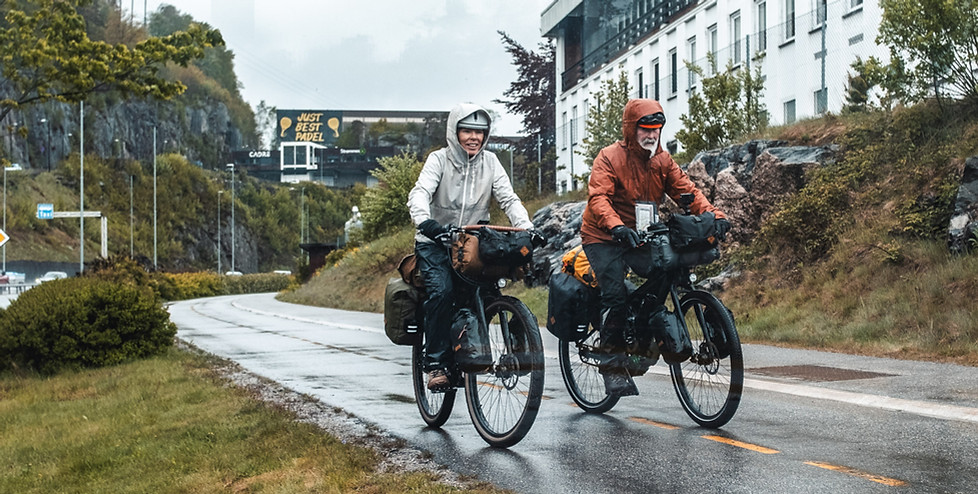


Hopefully the last day that I need to use the raincover for my iPhone, which I use as GPS.
I bought this cover in Stavanger after the first days of rain.
Apple is mentioning that the iphone is water resistant for max 30 minutes if submerged up to a depth of 6 meters.
What they do not tell you is that if a single drop of water enters your charging port, you cannot charge the iphone anymore until it's completely dried up.
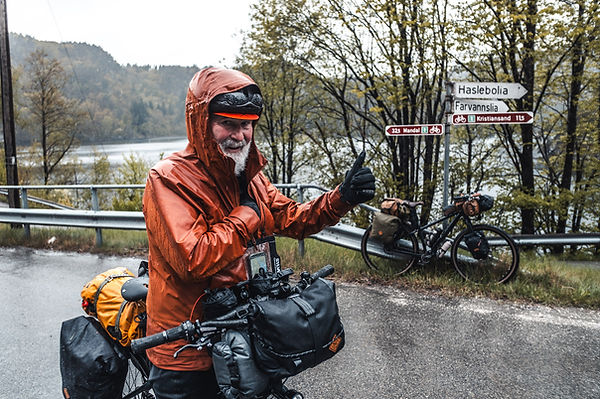
When expecting rain, our solution is to keep the iphone always at 100 % charged and carry it around the neck in a fully waterproof cover when it starts to rain.
Favorite Outtakes
On a trip, many photo's are taken but only a small selection makes it in to the main story hereabove.
This is mainly to avoid overlap, keep it visually appealing, provide valuable content, not too short and not too long, etc...
Hereunder some of our favorite outtakes which did not make it. Click on the photo to magnify.


When, where and how.

Where:
Date:
Today:
Eat or drink:
Groceries:
May 2/3
Scandic Neptun Hotel, Bergen
0 km
Bergen
Bergen

Where:
Date:
Today:
Eat or drink:
Groceries:
May 4
Scandic Neptun Hotel, Bergen
52 km - Bergen to Fitjar
Bergen, Os
Bergen, Lagunen, Os, Fitjar

Where:
Date:
Today:
Eat or drink:
Groceries:
May 5
Kråko Gjestetun
95 km - Fitjar to Haugesund
Haugesund
Sagvåg, Stord, Finnås, Haugesund

Where:
Date:
Today:
Eat or drink:
Groceries:
May 6
Apartment (Kopervikgata 1B), Haugesund
30 km - Haugesund to Skjoldastraumen
Haugesund
Haugesund, Skåredalen, Frakkagjerd, Aksdal, Skjoldastraumen

Where:
Date:
Today:
Eat or drink:
Groceries:
May 7
Apartment (Haugen 43), Skjoldastraumen
27 km - Skjoldastraument to Nedstrand / Ferry to Stavanger
xxx
Skjoldastraumen, Nedstrand kyrkje, Nedstrand

Where:
Date:
Today:
Eat or drink:
Groceries:
May 8
Villa Eckhoff, Stavanger
0 km - day of rest
Stavanger
Stavanger

Where:
Date:
Today:
Eat or drink:
Groceries:
May 9
Villa Eckhoff, Stavanger
106 km - Stavanger to Egersund
Stavanger, Egersund
Stavanger, Sunde, Tananger, Vigrestad, Egersund

Where:
Date:
Today:
Eat or drink:
Groceries:
May 10
Apartment (1 Kjeld Bugges gate), Egersund
73 km - Egersund to Flekkefjord
Egersund, Sogndalstranda, Flekkefjord
Egersund, Hauge, Åna-Sira, Flekkefjord

Where:
Date:
Today:
Eat or drink:
Groceries:
May 11
Apartment (Uenesveien 12), Flekkefjord
63 km - Flekkefjord to Farsund
Flekkefjord, Farsund
Flekkefjord, Feda, Farsund

Where:
Date:
Today:
Eat or drink:
Groceries:
May 12
Farsund Fjord Hotel, Farsund
0 km - Day of rest
Farsund
Farsund

Where:
Date:
Today:
Eat or drink:
Groceries:
May 13
Farsund Fjord Hotel, Farsund
40 km - Farsund to Lindesness
Farsund, Lindesnes
Farsund, Lindesnes

Where:
Date:
Today:
Eat or drink:
Groceries:
May 14
Lindesnes HavHotel
96 km - Lindesnes to Høllen
Lindesnes, Mandal,
Lindesnes, Vigeland, Mandal, Lunde

Where:
Date:
Today:
Eat or drink:
Groceries:
May 15
Åros feriesenter, Høllen
20 km - Høllen to Kristiansand
Tangvall, Kristiansand
Tangvall, Kristiansand